Nikon P-tactical Riflescope 223 15-45x20 Bdc 600 Review
I'll admit it. I've fallen into the "optic trap." In that location are more than a couple of, well, let's just call them lapses in judgment in my ol' pile of no-longer-used eyes. Oh, sure, when y'all're looking to equip a new rifle with glass, only you don't desire to spend a pocket-size fortune, those eyes sure wait highly-seasoned, with their MSRPs in the double digits and such. And then yous put them on your shiny new rifle, take them to the range to sight them in, and realize why they were selling for such low prices.
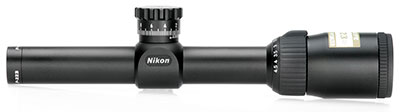
Compact and light, the P-223 won't add pregnant weight to an AR-fifteen carbine.
With scopes similar the Nikon P-223, though, at that place'southward simply no reason to fall into this trap any longer. For non much more than a bargain-basement scope, yous can equip your rifle with a quality optic from a visitor known for good glass. There's no need to put up with poor calorie-free transmission in a scope that only won't hold cipher when, for only slightly more than coin, there are much better options.
The P-223 line from Nikon is, apparently, aimed at the AR-xv-family of rifles, with Ballistic Drib Compensation (BDC) reticles designed for common .223 Rem. loads. The P-223 scope reviewed here came calibrated for utilize with 55-grain, polymer-tip projectiles, and has open circles that correlate with 200-, 300-, 400-, 500- and 600-yard distances when zeroed at 100 yards. It's a useful aiming system for holdovers, but for a i.5-iv.5X telescopic, something faster—like an open circle—should be function of the reticle.
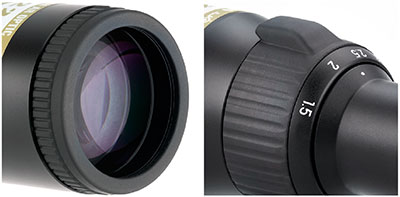
(l.) Generous eye relief yields more mounting options, and the large middle box makes fast target acquisition easier. (r.) Changing the magnification setting is made unproblematic and quick through the non-skid dial.
Everything else about the P-223 scope was exemplary, though. From mounting (using a Nikon M-223XR mount) to zeroing, the entire process was virtually every bit painless as it could exist. Rough-sighting the scope alignment through the bore at about v yards gave a point-of-impact depression and slightly left at 50 yards and required minimal adjustment. Had I been more than inclined to practice the math, it would have taken fewer rounds to dial the scope in—hardly a fault of the P-223, mind you—but even with less-rigorous attention to mathematics, dialing the Nikon in was simple.
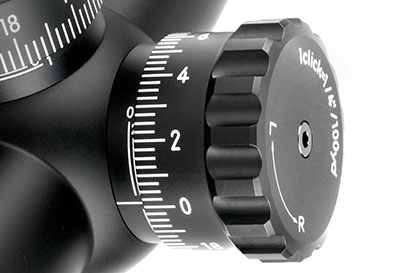
With a turret that tin be reset to zero one time the scope is dialed in, making changes on the fly becomes a simple task.
Making adjustments on the exposed turrets proved to be an exercise in easy. Both windage and meridian accept clean, clear marks indicated, with 1 click translating to .25-inch at 100 yards (roughly quarter-MOA; I reiterate my point about attending to mathematics). With indistinguishable shots at each adjustment, the scope was calibrated to dead-eye inside eight rounds, which was four rounds (two adjustments) besides many, had I been paying attention to converting the 100-m shift to 50-thousand. Suffice it to say, the turrets and scope were spot-on, regardless of how one approaches quasi-complex calculations.
Once dialed in, the P-223 did everything it was expected to, with no surprises. Running a uncomplicated box drill (center, and then shift POI up, right, downward and finally left to match up with the initial rounds on target), the adjustments are spot-on and repeatable. If you're a shooter who prefers to dial the elevation when shooting at different distances, the P-223 volition change quickly and hands. Hither'southward the best part—the turrets accept an adjustable cap that can be set to zilch at a given altitude, and then changed at will. If you nix at 100 yards, prepare the turrets to zero, then change your zero to 200 yards. All you need to practise to return your null back to 100 is dial the elevation dorsum to the zero mark. Information technology sounds harder than it is, and it sounds like shooting fish in a barrel.
 Changing magnification is too simple, with an oversize, rubberized power ring allowing fast transition between settings. Fine focusing is accomplished with the same blazon of ring on the eyepiece, although no adjustment was needed in testing.
If you're in the market for a fast-handling, low-magnification telescopic with crystal-clear glass and a cost indicate that won't break the bank, the Nikon P-223 fits those criteria well. Whether y'all're looking for an optic to go you started in iii-gun competition or to top a carbine for some long-range aid, the P-223 1.5-4.5x20 mm is a not bad option, all at a toll far less than a example of ammunition.
Source: https://www.shootingillustrated.com/content/nikon-p-223-1-5-4-5x20-mm/
0 Response to "Nikon P-tactical Riflescope 223 15-45x20 Bdc 600 Review"
Post a Comment